Skip to content
BeanFlow

The system that runs a coffee roastery

From the sackof green coffeeto the invoice.

Green coffee, purchasing, roasting with shrinkage to the gram, cupping, wholesale, a portal for cafés, receivables, food-safety registers and the cost of every bag — twelve departments on one database instead of seven spreadsheets and three programs.

  • roasteries wanted for the pilot
  • onboarding done together
Today at the roasterya sample day
06:42

900.0 kg received Ethiopia Guji, 15 sacks, lot BF:L:GL-0034

Inventory
08:15

Batch dropped 18.40 → 15.58 kg, 15.3 % shrinkage

Production
09:03

Quality gate: released cupping 84.25 pts, colour on target

Quality
10:20

Order from the portal Bistro Kazimierz, 24 kg, wholesale price list

Sales
11:48

Drum cleaning signed off GHP register, today's task closed

Compliance
13:30

Invoice FV 2026/09/118 PLN 4,812.00, due in 14 days

Money
Cost of a 250 g bag9.41 PLN
Margin, 30 days61 %
Typed in by hand0

Sound familiar?

The roastery outgrows the spreadsheet

Three people open the same file, shrinkage is typed in from memory, and the cost of a bag is two deliveries out of date.

On spreadsheets

  • Green coffee adds up until the first stocktake.
  • Shrinkage is one number for every roast.
  • The cost of a bag is recalculated once a quarter, by hand.
  • Shop orders are copied from an inbox into Excel.
  • “What are we roasting tomorrow” lives in the roaster's head.
  • Invoices in one program, stock in another, HACCP in a binder.

In BeanFlow

  • Every stock movement carries a lot, a weight and a date — and cannot be overwritten.
  • Shrinkage is measured for each batch, from two real weights.
  • The cost of a bag is recalculated backwards when the freight invoice arrives.
  • Orders from the B2B portal arrive on their own — nothing is copied out of an inbox.
  • The day's plan is built from open orders and what is on the shelf.
  • The same lot is in the food-safety register, in the cost of a bag and on the invoice.

What it covers

A roastery is not just a roaster

You are a warehouse, a production line, a laboratory, a wholesaler, a shop, an accounts department and a food-safety register, all at once. BeanFlow runs each of those pieces — and, more to the point, knows they are one chain: the sack that came in on Monday is inside the margin you work out on Friday.

Green coffee and buying

  • Lots with a cost per kilogram — freight and duty, layer by layer
  • Suppliers, contracts and purchase invoices
  • Supplier samples, side by side
  • Stocktakes, transfers, claims against a supplier
  • A buying plan from the consumption forecast, with DDS/EUDR
Production and roasting

  • Versioned recipes and bills of materials, blends before and after the roast
  • The day's board and a schedule built from orders
  • Shrinkage from two real weights, per batch
  • Artisan curves and reference profiles with an alert
  • Packing into SKUs, drawing the packaging down

Quality

  • SCA forms and blind cupping sessions
  • A quality gate — nothing ships until it is released
  • Trends, deviations and a log of decisions
  • Customer complaints tied to the lot and the batch
  • Consumer ratings left under the QR code

Sales and channels

  • Orders, per-customer price lists, standing orders
  • A B2B portal — cafés order for themselves, on their own price list
  • Over-the-counter sales and your own café
  • Shipments, returns, picking from the shelf
  • Shopify and WooCommerce shopssoon

Customers and wholesale

  • Account health — who used to order every month and stopped
  • Tasks, notes and the history of a conversation
  • Prospects, quotes and samples sent to a café
  • Equipment on site: grinders, machines, servicing
  • Segments as a saved question, not a saved list

Money

  • Cost of a bag and margin per product, channel and customer
  • Receivables, ageing, reminders, bank statement import
  • Sales and cost invoices in KSeFsoon
  • A cash forecast and a month that closes
  • A what-if simulator — electricity, exchange rate, the C price

Compliance and safety

  • GHP/HACCP registers with the due date written in advance
  • Maintenance: machine counters, service plans
  • A lot recall with a protocol and a measured time
  • Documents and certificates that warn before they expire
  • Waste, OSS, Intrastat, carbon footprint, transparency report

On the floor

  • Scanning a code leads to the job, not to a search box
  • Receiving, transfers, stocktakes and picking from a phone
  • The day's board and the cupping form work with no signal
  • PDF and ZPL labels, a BF: code on every parcel
  • A public lot page behind the QR code

Roastery services

  • Renting the roaster by the hour, with a bill and a cost
  • Toll roasting on somebody else's coffee, kept out of your own stock
  • A service price list with rates, a minimum and succession
  • A PDF protocol and a settled job
  • Consigned coffee, invisible to FIFO and to costing
12
departments in the menu
19
reports, ready to run
1
database, one login
0
spreadsheets to reconcile

From the sack to the margin

Five steps where the grams count

The same lot goes through the system once. Every step leaves a number nobody has to copy anywhere.

  1. 01 · Receiving

    The sack arrives with a price, not a sticky note

    A delivery opens a lot: weight, supplier, location, certificates. The freight invoice adds a layer of cost rather than overwriting the last one.

    BF:L:GL-2026-0034

    900.0kg

  2. 02 · Roasting

    “Start” takes the coffee off the shelf

    A batch planned from the recipe, lots proposed by FIFO, coffee drawn down to the gram. The Artisan curve lands next to the batch, with no rebuilt roaster.

    Charge

    18.40kg

  3. 03 · Shrinkage

    Two weights instead of one average

    Dropping the batch books the roasted coffee in and closes its account. Shrinkage is visible per recipe, per machine and per person — with an average, a deviation and a trend.

    Drop 15.58 kg

    −15.3%

  4. 04 · The bag

    The smallest unit of cost

    Packing turns loose coffee into a SKU on the shelf and draws the materials down. The cost of a bag is coffee, packaging and work — together, not in three files.

    Cost of goods

    9.41PLN

  5. 05 · Margin

    At last you know what earns

    Revenue from the bags actually shipped, set against the cost of exactly those bags. Not “roughly, this month” — these units, this customer, this channel.

    Margin, 30 days

    61%

Money

Do you know what one bag of coffee costs you?

A spreadsheet cannot answer that, because the answer changes with every delivery, every rise in the electricity bill and every freight invoice that arrives three weeks after the roast.

BF:B:RB-2026-0082batch account

Charge

18.40kg

Drop

15.58kg

Artisan curve

15.3 %shrinkage — from two real weights, not from an average somebody remembers

Coffee in a 250 g bag5.89 PLN

Packaging from the bill of materials2.14 PLN

Labour, energy, depreciation1.38 PLN

Cost of one bag

9.41 PLN

Price 24.12 PLN

margin 61 %

  • Coffee at the roasted-kilogram costShrinkage is already in the price, so a bag does not pretend to cost what green coffee costs.
  • Rates frozen onto the batchLabour, electricity and depreciation as they were on the day of the roast. A rise in May does not reprice a batch from March.
  • The freight invoice recalculates backwardsA layer of cost joins the lot, and the batches, bags and margin follow — on their own, with nothing recalculated by hand.
  • Margin from the bags actually shippedBy product, variant, channel and customer, with a comparison between periods and a month that closes for good.

The product, not a promise

This is what it looks like once you are in

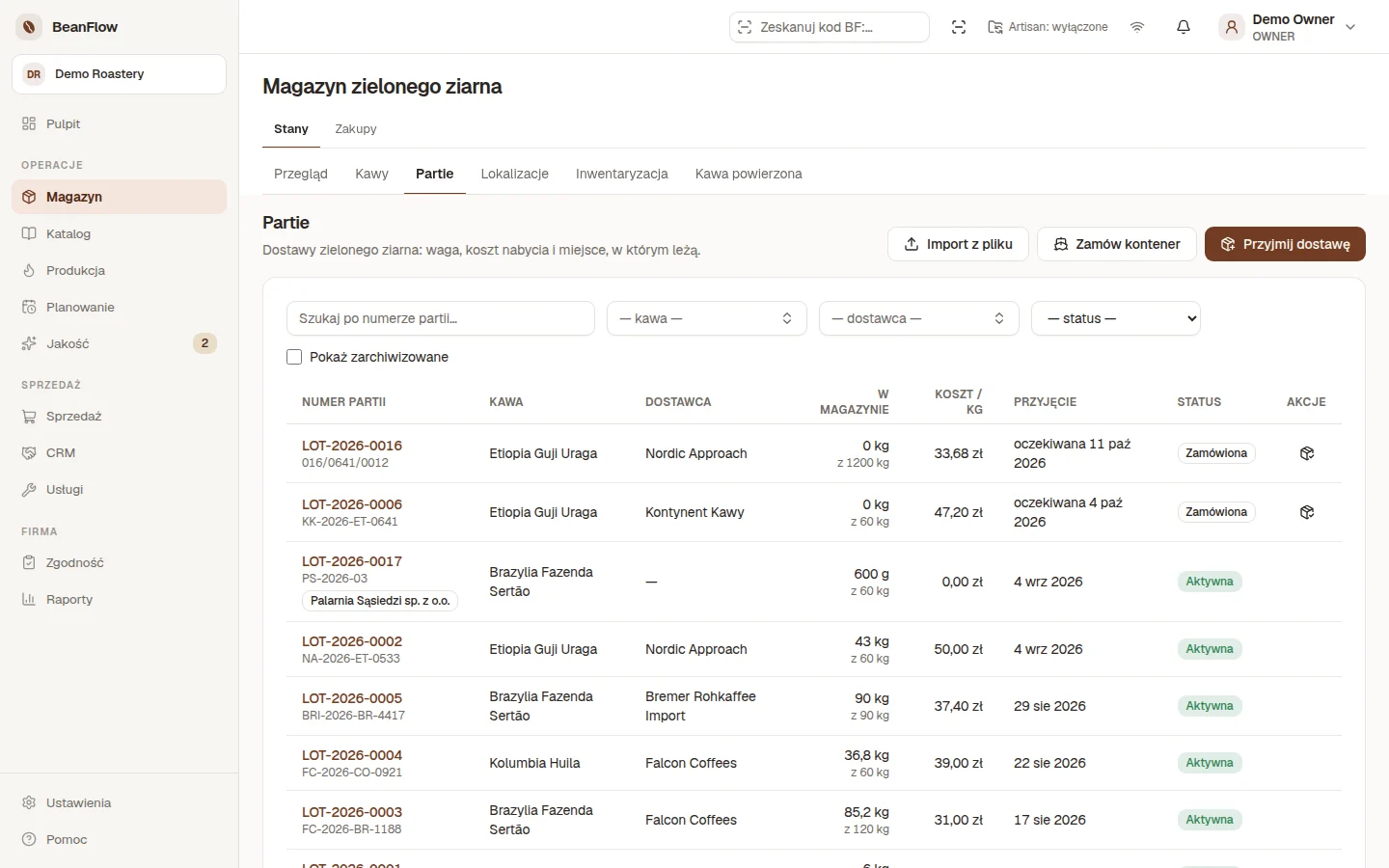
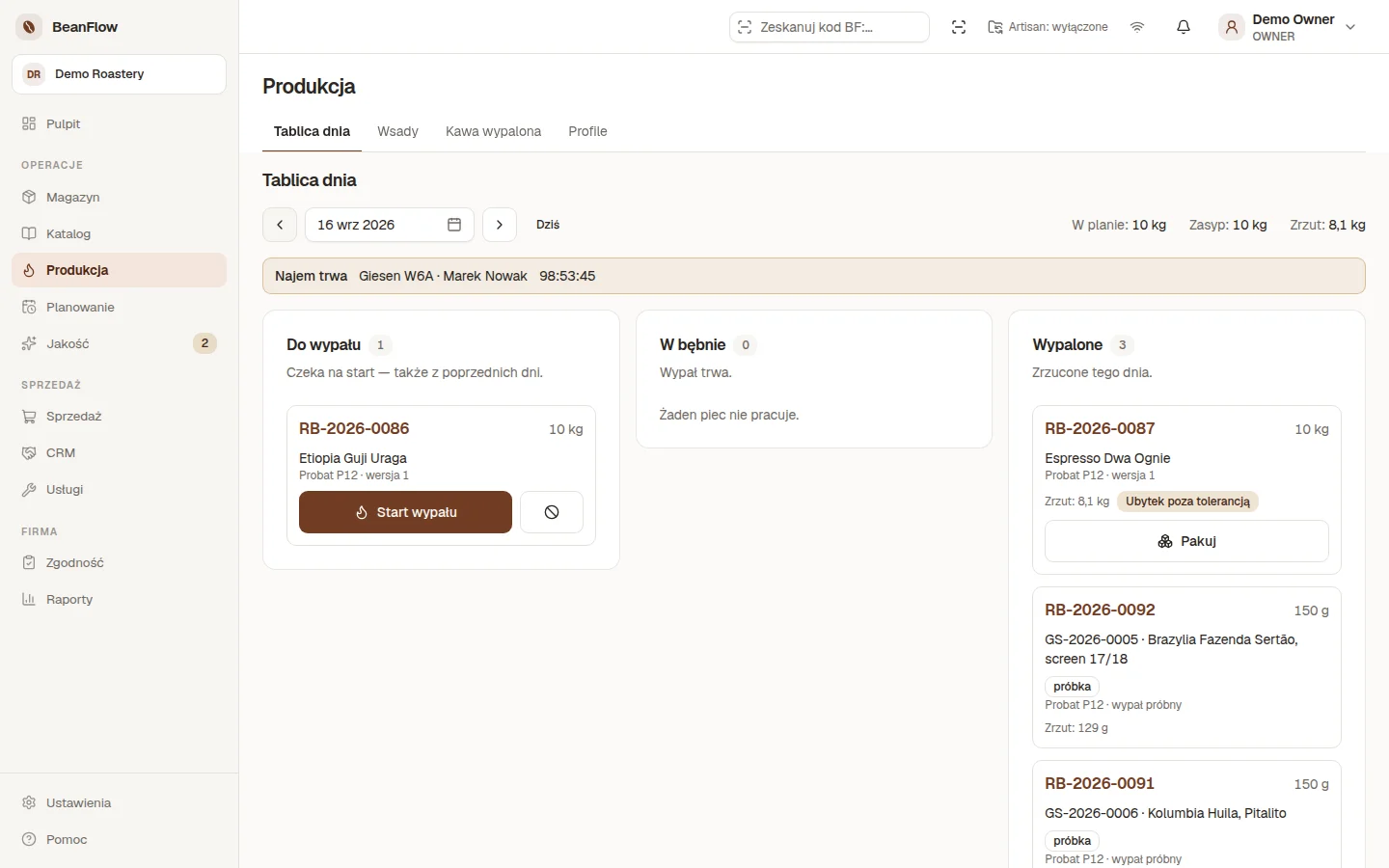
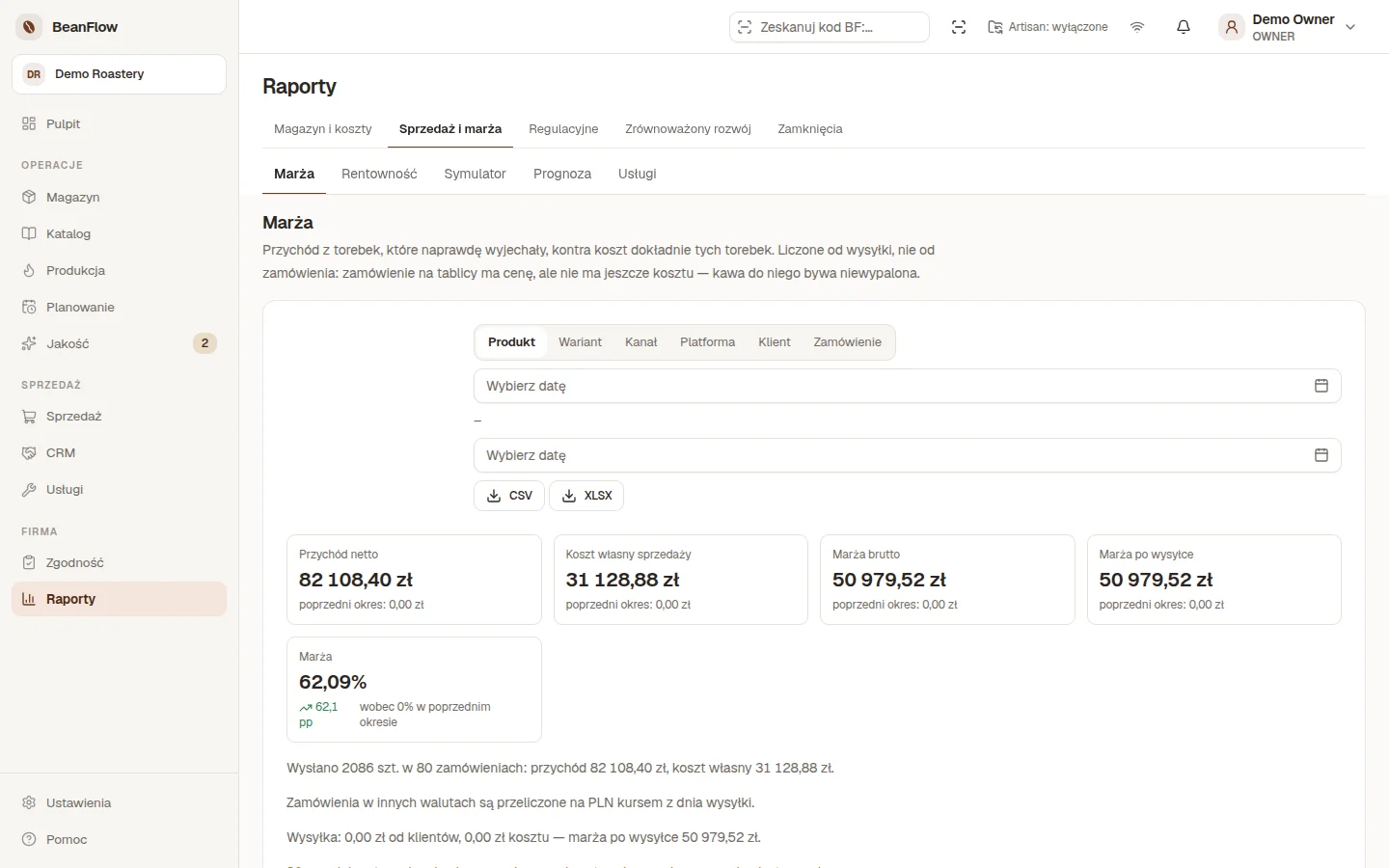
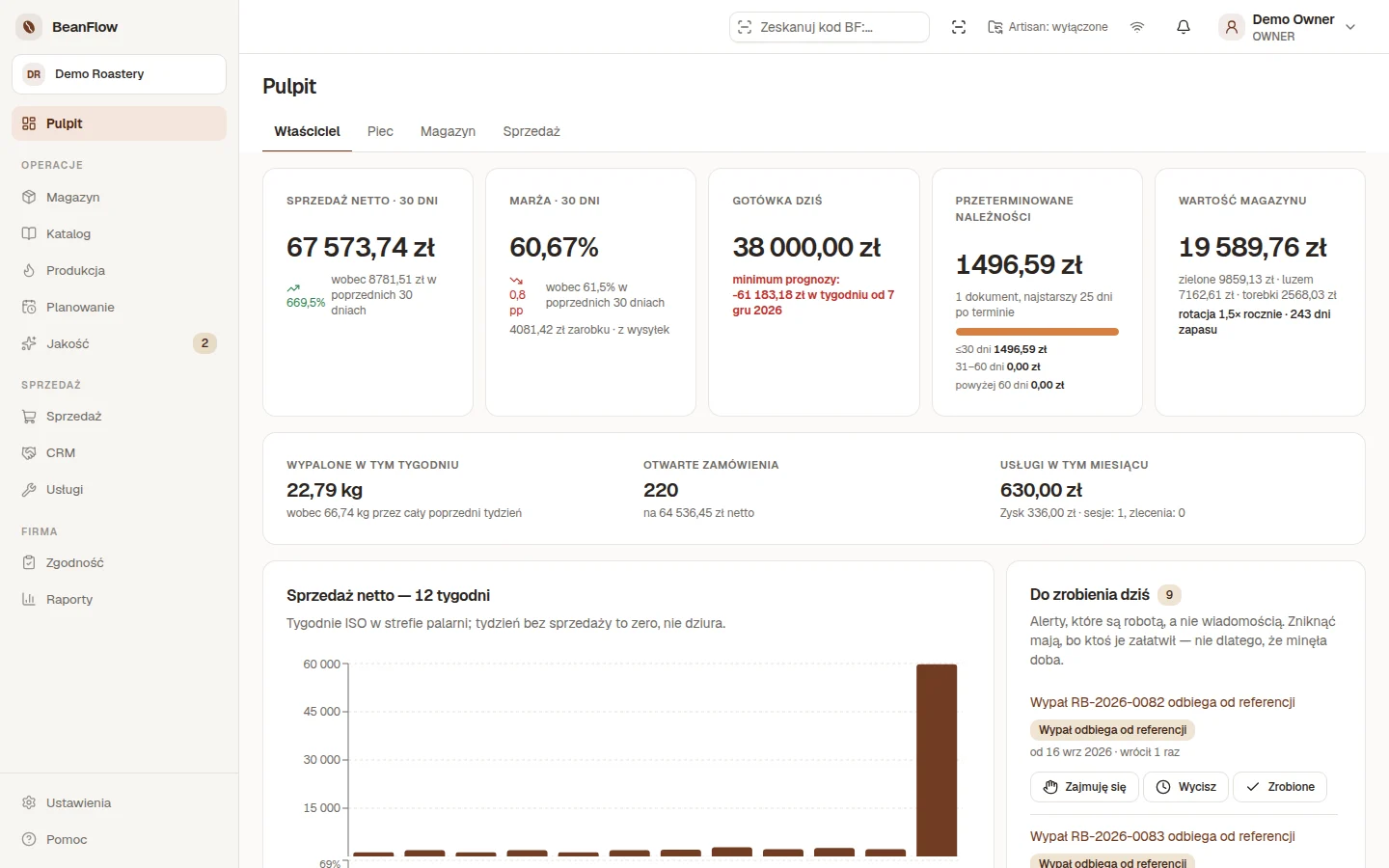
The four screens a roastery spends its day on. Taken from the running system, on the demo roastery's data.

app.beanflow.pl/
The owner's dashboard in BeanFlow: five tiles with the month's numbers, twelve weeks of sales bars and the list of things to do today.

Net sales, margin, cash with its forecast, overdue receivables and the value of the store — in one request and from one moment.

The numbers on these screens come from the demo roastery, so they are invented — that is the point. The screens are real.

Pilot programme

We are looking for roasteries to join the pilot

The system runs in production and keeps a whole roastery — stock, roasting, quality, sales, receivables and the registers an inspection asks for. Two things are still missing: fully self-service sign-up and some of the shop integrations. So we set your account up together with you.

What you get

  • The full system, with no feature held back, during the pilot and after it.
  • Onboarding done together: we move your lots out of the spreadsheet and walk the first roast with you.
  • A direct line to the team — you write to the people who write this.
  • A say in what gets built next: whatever blocks your roastery goes before whatever looks good.

What we ask for

  • That you actually work in it — one roastery counting real batches is worth ten test accounts.
  • That you are reachable when something needs talking through, and straight with us when it is awkward.
  • That whatever does not work reaches us right away — a screenshot and one sentence are enough.

The pilot stays with you for good

A roastery that joins the pilot keeps BeanFlow free forever — after the programme ends and after the commercial launch as well. There is no date on which that runs out, and no asterisk underneath it.

Apply with your roastery

We usually answer the same working day.

Before you type your data in

The things you are going to ask anyway

Roasteries separated by the database

Not only by the application: each roastery has its own space, enforced by policies inside PostgreSQL.

A processing agreement and subprocessors

GDPR, a data processing agreement and a published list of subprocessors. Changes are announced 14 days ahead.

Data leaves as easily as it arrived

Every report to CSV and XLSX, lots from a file at the start. You leave with everything you put in.

PL, EN, DE and your currency

The interface, the documents and the invoice in the currency you keep your books in.

Questions

The ones we get most often

How finished is the product?

It runs in production and keeps a whole roastery: green coffee stock, roasting with shrinkage, quality, recipes, sales, receivables and the registers an inspection asks for. Fully self-service sign-up and some of the shop integrations are not there yet — those land during the pilot.

Do I have to roll all of it out at once?

No. You start with one lot of green coffee and one roast — the rest is switched on and waiting, and nothing has to be configured up front. Roasteries usually add quality and sales in the second week, and the registers and reports when an inspection or the bookkeeper turns up.

What happens to my data if the pilot does not work out?

It stays yours. Every report exports to CSV and XLSX, and lots, batches, recipes and cupping sheets are where you entered them.

Do I have to rewire my roaster or buy probes?

No. Roast curves are imported from Artisan, which you are most likely already running. We do not connect to the roaster's controller and we do not sell hardware.

Which languages and currencies does it work in?

The interface speaks Polish, English and German. Each roastery sets its own currency, weight unit and time zone, and billing is in the currency you keep your books in.

Will you move my data out of spreadsheets?

Green coffee lots are imported from a CSV file during first-run setup. For a larger migration, write to us and we will go through it together.

Is each roastery's data separated?

Every roastery has its own isolated data space, and it is the database itself that enforces this, not only the application.

Fifteen minutes

See your first batch in numbers

We will show you the system on your own numbers: one of your lots, one roast, and at the end the cost of a bag. Fifteen minutes, no strings attached.

BeanFlow · 30 s · subtitles PL / EN / DE